Nexcorio DataFeed v3 now streaming NSE & BSE F&O ticks, snapshots and option Greeks over one WebSocket.

See the specs

Algo platforms · Market data · Research

Market data, screening, F&O automation and a market wire - engineered by one desk.

Five products on one data spine: Nexcorio DataFeed (NSE/BSE tick, option-chain and historical APIs), Nexcreener (a screener that shows the formula behind every number), the FnO Algo Platform (a multi-threaded Java 21 engine with a pre-trade risk veto), Nexcorio Pulse (market news in 60 words) and custom trading systems built to your rules.

  • Java 21 engine, 1 process, many threads
  • NSE, BSE, NFO and MCX coverage
  • You keep the strategy, we hand over the code

The desk

One workspace: quotes, option chain, greeks, P&L and engine health

A mock-up of the terminal our strategies report into, so you can see the shape of the telemetry before you buy anything. It is a screenshot of a demo run - not a live quote feed, and not a performance record.
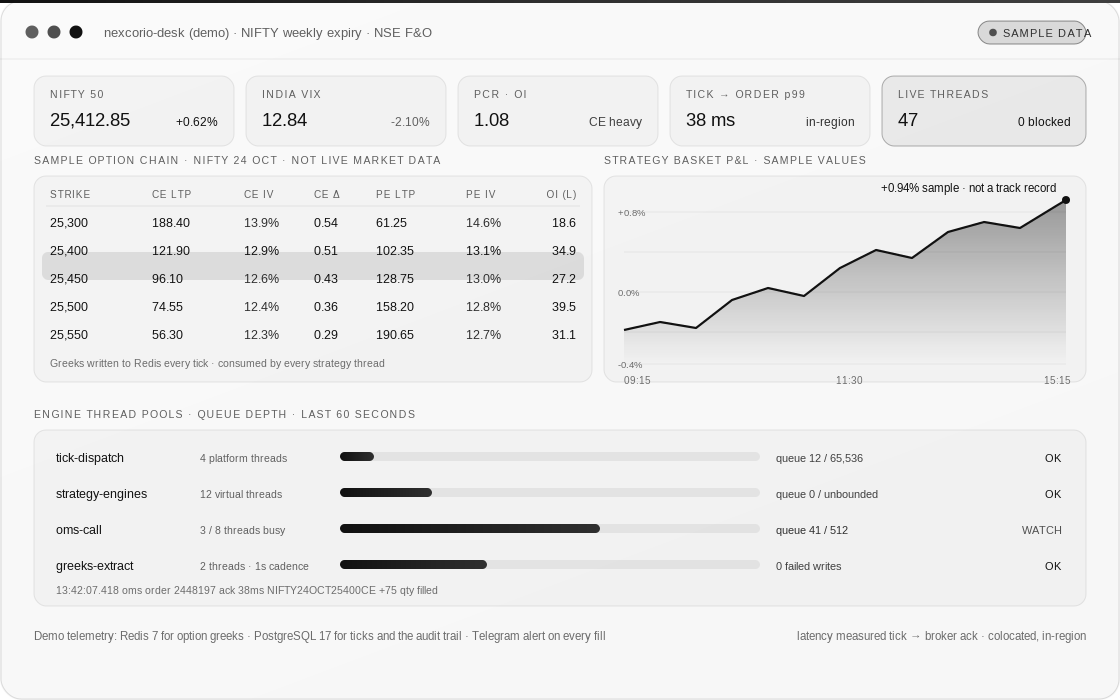
Illustrative screenshot of the Nexcorio desk terminal: sample index values, a sample option chain with implied volatility and delta, a sample strategy-basket P&L curve and the thread-pool monitor of the Java engine.
Illustrative screenshot - sample values, no live prices. The panels and the thread-pool monitor are what a Nexcorio desk actually shows; the numbers are demo values, so nobody mistakes a mock-up for market data.
47 Threads in the reference F&O deployment - dispatch, engines, OMS, greeks, watchdog
38ms Tick-to-order p99 on a colocated, in-region deployment
1200+ Ratios, factors and derived metrics inside Nexcreener
5 Products on one data spine: feed, screener, algo, news, research

Figures describe the Nexcorio reference deployment and Nexcreener's metric catalogue. They are engineering measurements, not a promise of trading returns.

Product details

What each product actually does

Most traders stitch together a data vendor, a screener, a charting tool, a news app and a developer. Nexcorio builds all five on one data spine, so a number you see in a screen is the same number your algorithm trades on. Here is each of them, in specifics.

Equity research & model portfolios

For family offices, foreign investors and institutions: ranked stock ideas, full research notes with thesis and risks, and model portfolios with position sizing - written by people who also build the engines.

HNIFIIInstitutions
See the research desk

Why Nexcorio

We speak both languages: market microstructure and production code

Nexcorio Algorithms LLP is not a coding shop that learned about markets, and not a trading desk that hired a developer. We build the feed, the screener, the engine and the research, so the whole chain is designed by the same team that has to keep it alive on an expiry Thursday.
  • Order-book literacy. Our strategies read open interest, IV percentiles, greeks and depth - not just candles.
  • Broker-agnostic by design. Zerodha Kite, Fyers, Interactive Brokers and in-house order routers behind one interface.
  • Risk before speed. Every order passes a pre-trade veto: mandate, margin, order storm and expiry-day breaker.
  • You keep the IP. The strategy stays yours; the code is delivered to you with tests and documentation.
  • One team, one number to call. Data, execution, hosting and research in a single engagement.
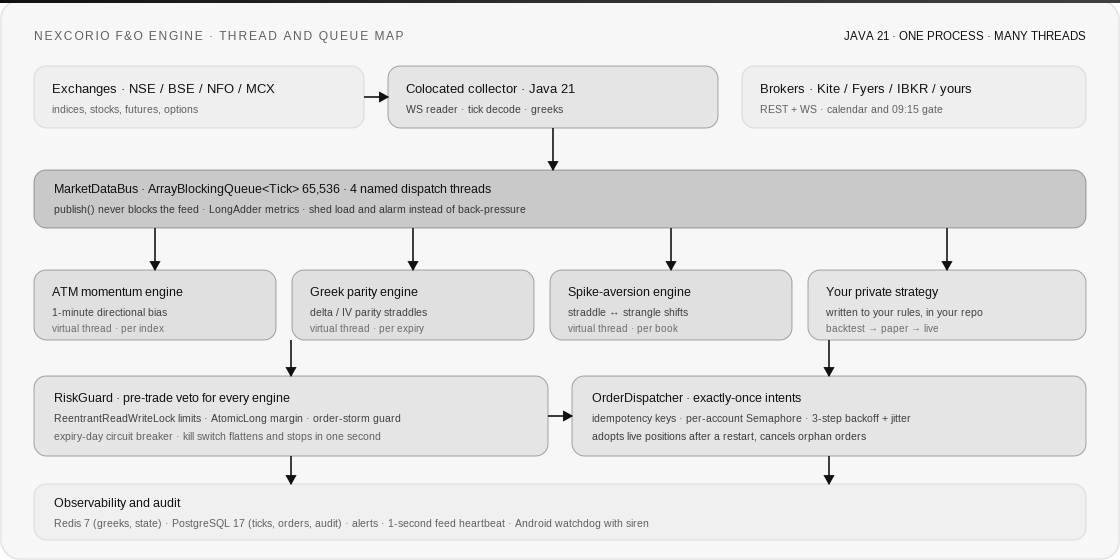
Architecture diagram of the Nexcorio F&O engine: exchanges and brokers feed a colocated Java collector, a bounded market data bus, parallel strategy engines, a risk guard, an idempotent order dispatcher and an observability layer.
One process, many threads. The reference F&O deployment: a bounded tick bus, virtual-threaded strategy engines, a single risk veto and an order dispatcher that survives a restart.

Who we work with

Four kinds of client, four different conversations

Tell us which one you are and we will start from the right place - a private mandate, an automation sprint, an institutional data contract or a white-label platform.

You have capital and conviction - what you do not have is bandwidth

A family office or an HNI trader does not need another dashboard. You need your existing, tested discretionary rules running the same way at 09:16 and at 14:55, without you watching every tick.

  • Rules documented from your journal, then coded and unit-tested
  • Mandate limits, per-strategy caps and a kill switch you control
  • Backtests on five years of tick and option-chain history
  • An order, fill and P&L audit trail you can reconcile
  • Model portfolios and research if you also want ideas

Under the hood

Java enterprise concurrency, in the service of one number: your fill price

Trading systems fail in boring ways - a stalled feed thread, a duplicated order, a risk check that ran after the order had left. Our engine is built on four rules: never block the feed, never send twice, never bypass risk, and always be able to explain what happened.
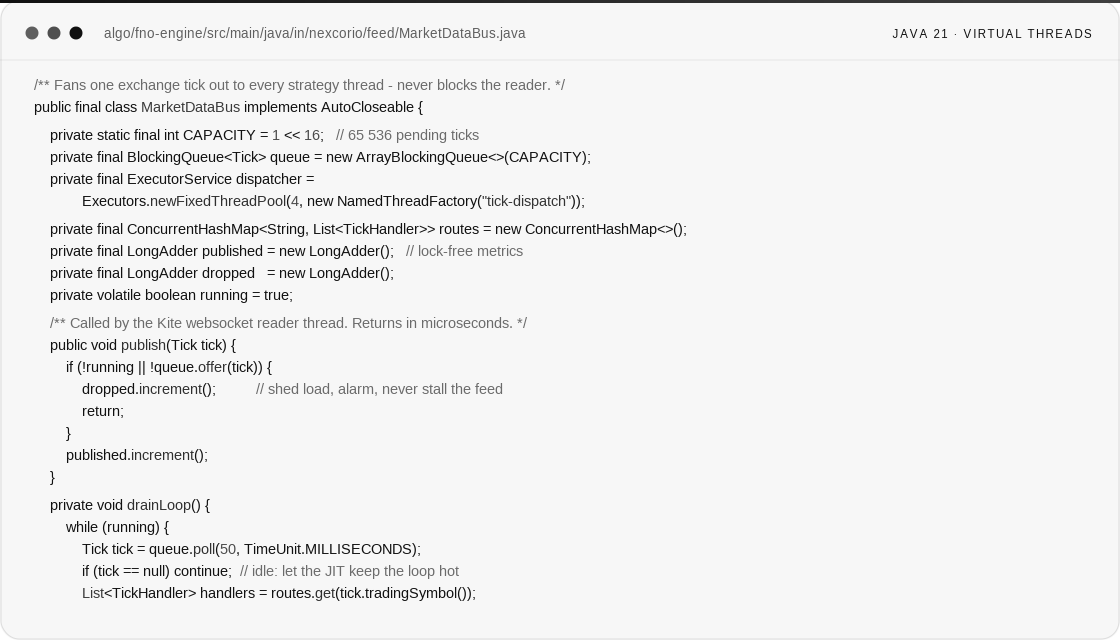
Java source listing of MarketDataBus: a bounded ArrayBlockingQueue tick bus, a four-thread dispatcher with named threads, a ConcurrentHashMap routing table and LongAdder counters, where publish never blocks the feed.
Rule 1 - never block the feed. Ticks land in a bounded queue and are dispatched by a small pool of named threads. If the queue fills, the engine sheds load and raises an alarm instead of stalling the reader.
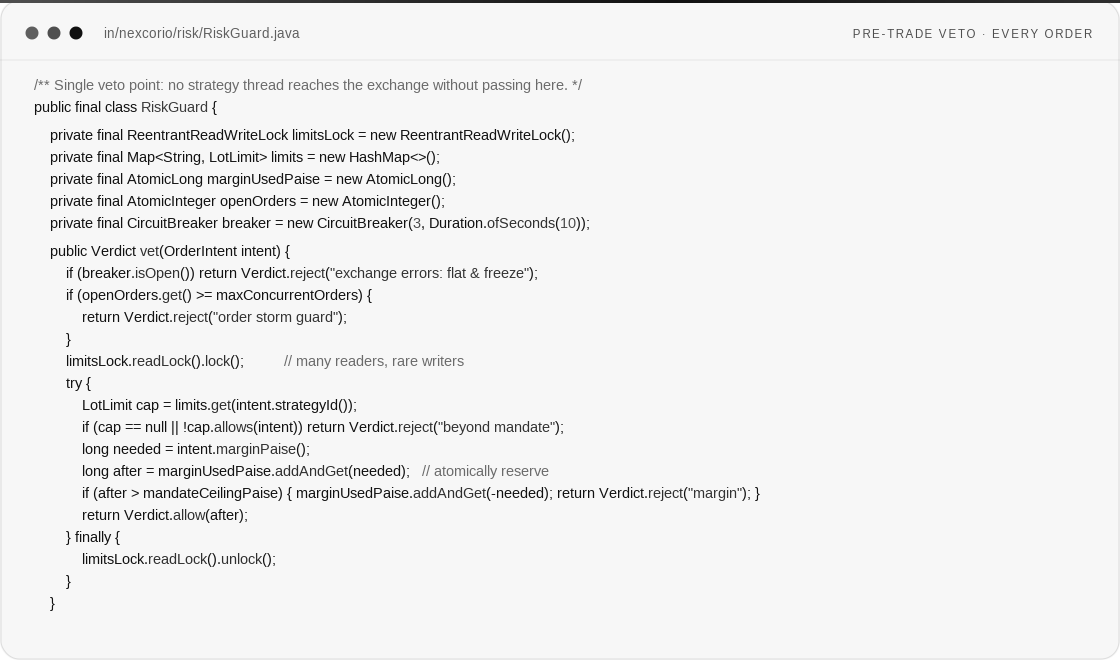
Java source listing of RiskGuard: a ReentrantReadWriteLock around per-strategy lot limits, AtomicLong margin accounting, an order-storm guard and a circuit breaker that every strategy thread passes before an order is sent.
Rule 2 - never bypass risk. Every intent passes one veto point: mandate, margin, order rate and an expiry-day circuit breaker. Risk is code with tests, not a setting somebody forgot.
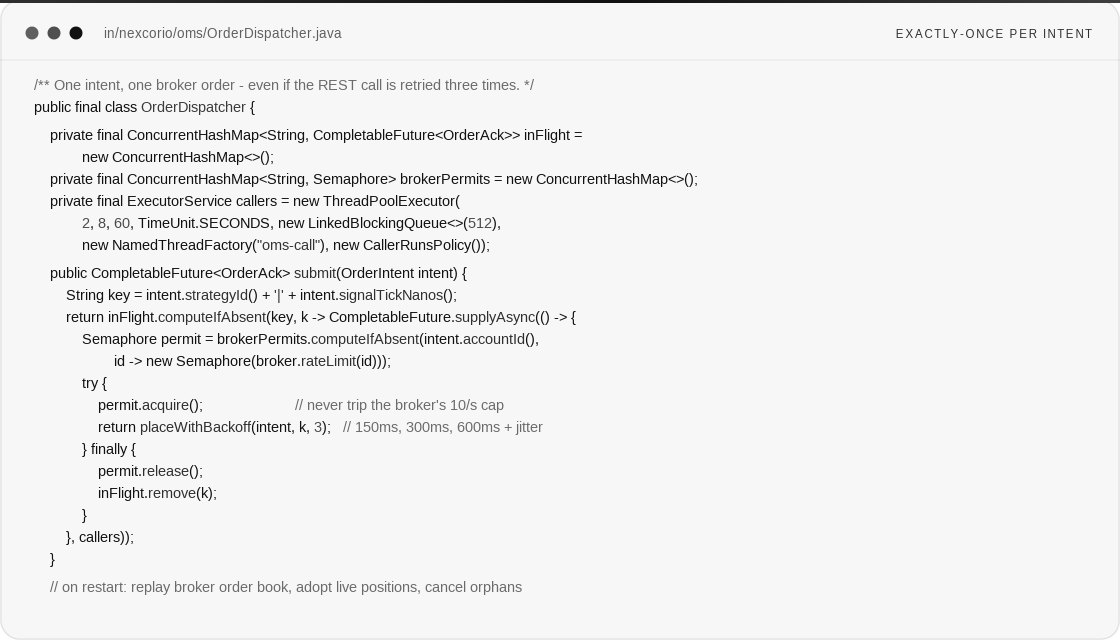
Java source listing of OrderDispatcher: an idempotency-keyed ConcurrentHashMap of in-flight orders, a per-account Semaphore for broker rate limits, exponential backoff with jitter and CompletableFuture acknowledgements for the strategy thread.
Rule 3 - never send twice. Intents are idempotent: the same signal tick cannot become two broker orders, even across a restart, a retry or a network flap.
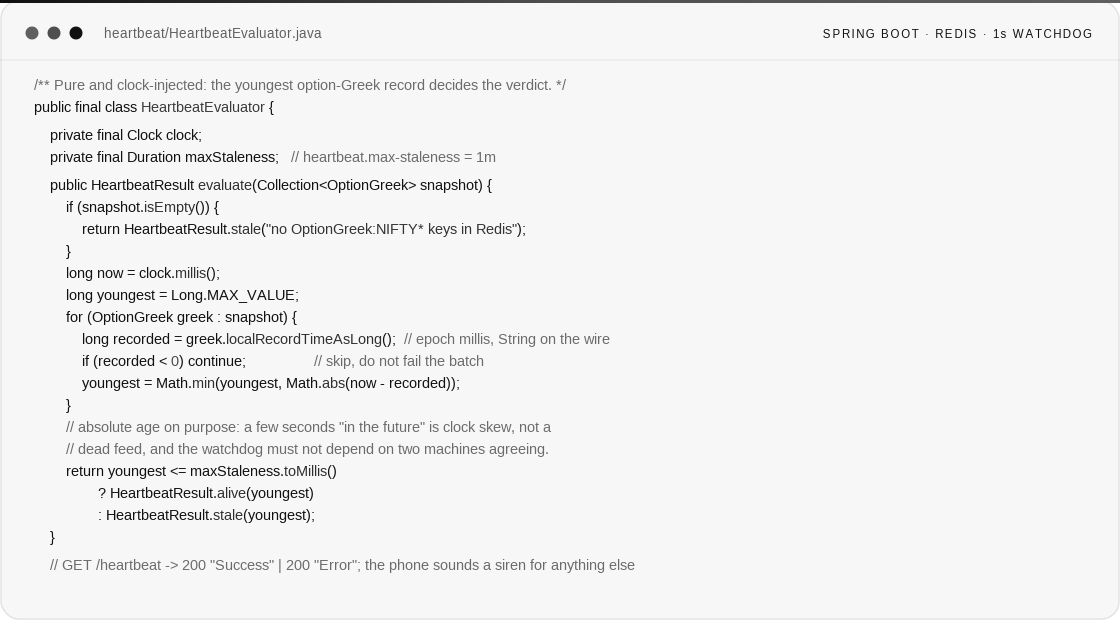
Java source listing of HeartbeatEvaluator: the youngest option-greek record decides whether the feed is alive, using an injected clock and an absolute age so two unsynchronised machines cannot raise a false alarm.
Rule 4 - always know. A one-second heartbeat reads the option greeks in Redis and answers Success or Error. A silent feed alarms the desk and the phone.

What one strategy thread looks like on the inside

in/nexcorio/engine/AtmMomentumEngine.java Java 21
// Illustrative excerpt written for this page: one strategy thread out of many.
public void run() {
    awaitStartGate();                        // every engine starts on the same tick
    while (!exitThread && !timeout(15, 15, 0)) {
        OptionGreek atm = greeksCache.youngest(mainInstrument);   // Redis, refreshed per tick
        if (atm == null || atm.ageMillis() > 3_000) { sleep(1); continue; }

        Signal signal = evaluate(atm, premiumSeries.lastMinute());
        if (!signal.isActionable()) { sleep(1); continue; }

        Intent intent  = signal.toIntent(noOfLots, maxFundAllocated);
        Verdict verdict = riskGuard.vet(intent);        // the single veto point
        if (!verdict.allowed()) {
            telegram.info("skipped: " + verdict.reason());
            sleep(5);
            continue;
        }

        dispatcher.submit(intent)
                  .thenAccept(ack -> positions.record(ack))
                  .exceptionally(err -> { telegram.alert(err); return null; });

        sleep(2);                          // per-engine cadence, not a global tick
    }
    flattenAndReport();                     // 15:15 square-off, every single day
}

The code in these images and listings is original Nexcorio sample code, written for this page to illustrate the patterns our platform uses. It is not copied from any third-party project or book.

Backtest on the same code path

The clock is injected, not faked: the strategy runs the identical loop against historical ticks, so what you tested is what trades.

Tested where it matters

Unit tests cover risk veto boundaries, order idempotency, greeks decoding and the heartbeat rule - the four places where a bug costs real money.

Logs you can read at 09:20

Every signal, veto, order and fill is logged with its reason and pushed to your Telegram or inbox within the second.

How an engagement runs

From a conversation to a live engine in five short stages

No discovery theatre and no 60-page proposal. You get a feasibility read within 24 hours and a fixed-scope quote after a two-hour rules workshop.

  1. Discover A 45-minute call, NDA first. What you trade, how you decide, where the manual process hurts.
  2. Specify Your rules written back to you in plain English with edge cases named, plus risk rails and a fixed quote.
  3. Backtest Five years of tick and option-chain history, with slippage, brokerage and the bad days included.
  4. Paper, then pilot Live feed, no capital, then a small-size pilot inside your limits - with the kill switch in your hand.
  5. Run and grow Monitored production, weekly review, new instruments or strategies as the mandate widens.

What a 24-hour proposal needs from you

  • Which instruments and expiry you trade (NIFTY, BANK NIFTY, stocks, commodities)
  • Your entry and exit logic - a paragraph or a screenshot is enough to start
  • Your broker, and whether the API is enabled on your account
  • Your capital, per-trade size and the loss you refuse to cross
  • Who acts when the engine calls you at 09:20
Send your rules now

What you receive in return

  • A feasibility verdict: buildable, buildable with caveats, or not worth automating
  • An architecture sketch: data path, threads, risk rails, deployment target
  • A fixed price with milestones, and an honest estimate of achievable latency
  • A sample backtest of a proxy rule, so you can judge our rigour before you buy
  • The name and profile of the engineer who would own the build

If automating your edge is a bad idea, we will tell you that too. It has happened, and it saved the client a great deal of money.

Research desk

Stock picks with a thesis, a valuation and an exit

For HNIs, family offices and foreign investors who need India exposure they can defend at an investment committee: ranked ideas, model portfolios with sizing, and a written review date for every position.

  • Model portfolios. Core India Quality, an F&O income overlay and Smallcap momentum - each with position sizing and rebalance history.
  • Note anatomy. Thesis, what must be true, valuation range, downside case, catalysts and a mandatory exit rule.
  • Screened universe. Ideas come out of Nexcreener screens, not out of a broker's daily mail.
  • Doctrine of evidence. Every number is traced to a filing, with the period and adjustment history attached.

Monthly letter, weekly screen

One long letter a month on positioning and risk, one short screen every week with what changed and why. Nothing in between.

Risk-first language

Every idea is published with the loss it can cause and the condition under which we would be wrong. Research is general information, not advice on your account.

In their words

What clients say about the work

Client names are withheld on request. Attribution and reference calls can be arranged under NDA while you evaluate us.

"Eleven years of discretionary F&O experience and a spreadsheet - that is what I handed over. Nexcorio put the rules into a Java engine in seven weeks, and the difference is not speed: it is that I no longer make the 14:00 mistake. The pre-trade veto has stopped me twice from over-sizing on expiry day."
Family office principal Bengaluru · discretionary F&O mandate, automated in 2024
"It is the first screener where I can show a client the formula behind a number. We run the same universe in the research note and in the trading engine, so nothing drifts between what we publish and what we hold."
Head of research India-focused fund, Singapore · Nexcreener and DataFeed
"The heartbeat endpoint and the phone alarm saved a full trading day for us. The feed went quiet at 09:52, the siren went off, and we were flat before the move. Nothing else in our stack told us anything."
Proprietary trading desk Mumbai · FnO Algo Platform in production since 2024

Quotes are reproduced with permission; client identities are withheld at their request. Past experience and backtested results do not guarantee future outcomes.

Questions we get asked

Straight answers before you spend money

What exactly does Nexcorio do, and what does it not do?

We build technology and publish research: market data feeds, screening software, algorithmic trading engines, news delivery and research notes. We are not a broker, we do not hold your money, we do not manage portfolios and we do not give personalised investment advice. Execution happens in your broker account, under your credentials and your mandate.

Do I need a broker API, and which brokers do you support?

Yes - automation needs API access on your own broker account. We have production experience with Zerodha Kite Connect, Fyers and Interactive Brokers, and we have written adapters for other REST-based brokers. If your broker has no API, we will say so on the first call rather than after you have paid.

How long does a custom algo build take, and what does it cost?

A single-strategy automation build is typically six to eight weeks from kick-off to live, plus a paper-trading window agreed with you. Price depends on strategy complexity, the number of brokers and the deployment model; you get a fixed-scope quote with milestones within a day of the rules workshop. The ladder is on the pricing page.

Is your data feed good enough to trade on in production?

Yes - our own engines trade on it. That is the point of building the feed and the execution engine in one team: the data path gets tested where it hurts, on expiry Thursdays. We show you the latency distribution and the gap-fill behaviour during evaluation, and every feed carries a heartbeat and an alert so you are never trading silently on stale data.

Who owns the code, the strategy and the data?

You do. Your strategy and the source code we write for you are yours, handed over with unit tests, documentation and deployment scripts. We keep only our general-purpose platform components and know-how. Your market data stays in your tenancy, and every engagement starts with an NDA.

What happens if something breaks at 09:20?

Every engine has a kill switch that flattens positions and stops the loop within a second, and every failure raises a Telegram or e-mail alert. The heartbeat service watches the feed, and the phone app sounds a physical siren if the data goes quiet. Managed engagements also carry an escalation number and a support window that covers market hours.

Can you work with my existing developer or IT team?

Often that is the best arrangement. We can deliver the platform and hand operations to your team, run a joint build where our engineers take the concurrency-heavy parts, or simply supply feed and screening APIs into a product your team already ships. Tell us which on the first call.

Do you publish performance numbers for your strategies?

We publish engineering measurements, and for research we share model portfolios with their rebalance history and full risk disclosure. We do not publish a headline return figure, and we do not take arrangements where a track record can be cherry-picked. Anything we show you arrives with the drawdown, the assumptions and the date range attached.

Start the conversation

Send us your strategy. Get a feasibility read within 24 hours.

Share your rules - an Excel sheet, a screenshot, even a screen recording of how you trade - and we come back with the build scope, expected latency, risk rails and a fixed quote. No obligation. NDA signed before we look at anything.

  • Fixed-scope proposal in one working day
  • Named engineer on the call, not a sales deck
  • Your strategy stays your IP - we build, you own